Research
UK Food Labelling Recall Index 2021–2026
394 of 735 FSA alert incidents contain defined labelling or packaging wording. Explore the 2021–September 2026 data, methods and reusable charts.
- Period
- 2021–30 September 2026
- Authors
- Artwork Management UK research team
- Status
- Published
- Last updated
- 2026-09-30
Executive summary
Our first automated edition examines 843 official Food Standards Agency notices published from 1 January 2021 to 30 September 2026. After merging update chains, 735 incidents remain. 394 (53.6%) contain the explicit labelling, undeclared ingredient or packaging wording defined below.
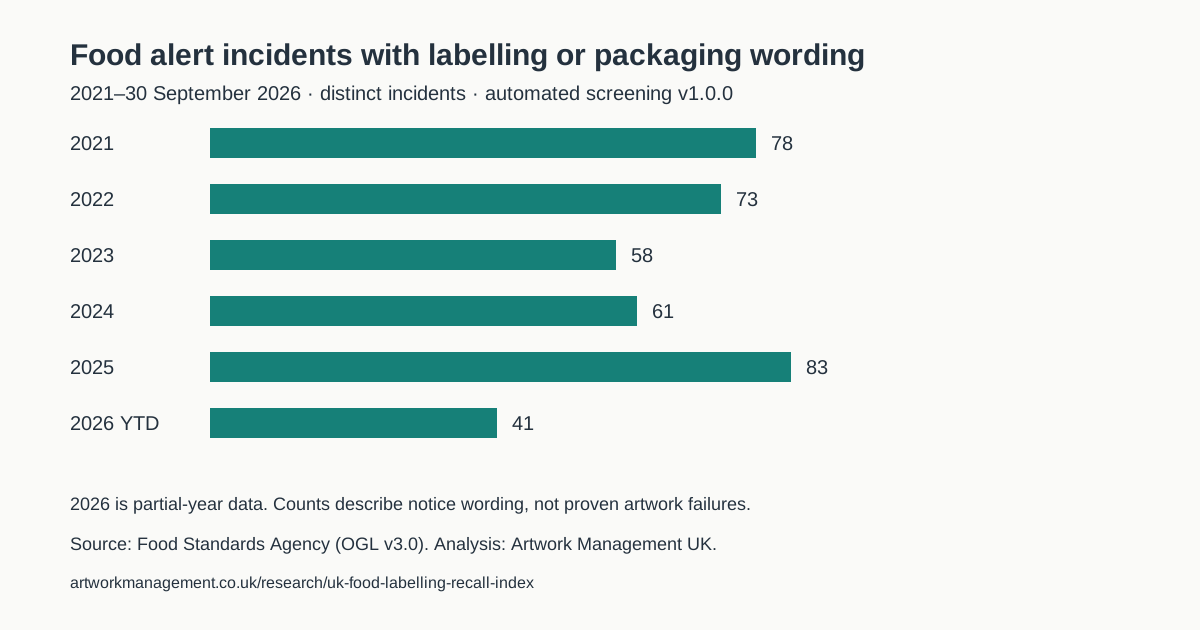
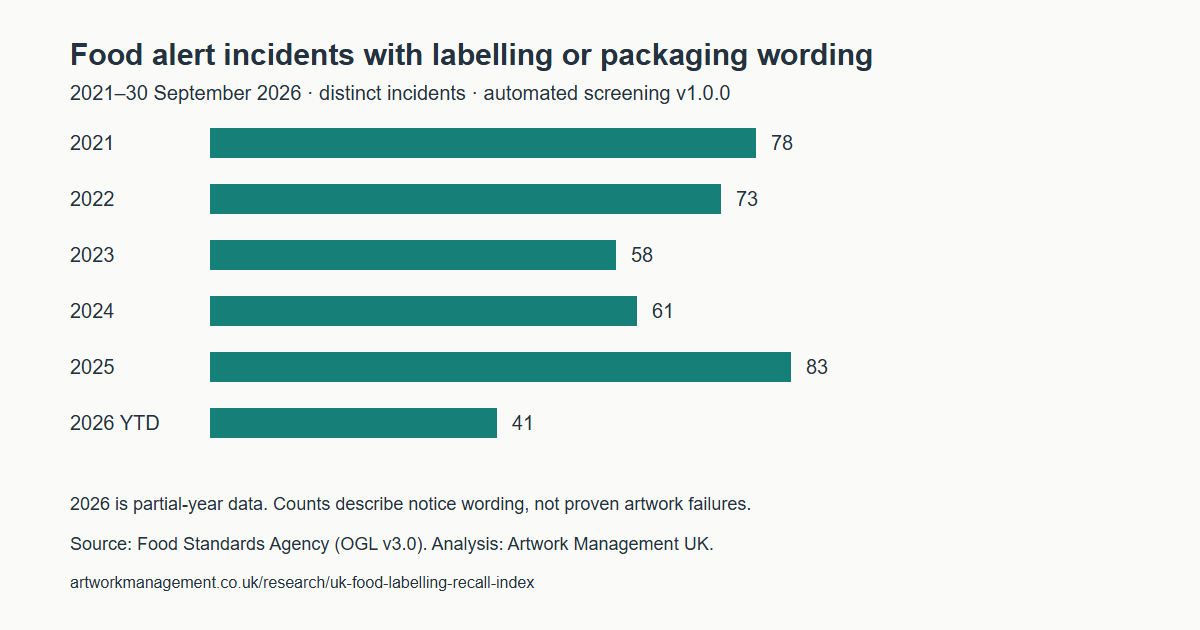
This is a reproducible screening index of official alert wording, not a count of proven artwork failures. Its value is the open incident ledger: readers can trace each classification to the original notice and challenge the rules. The 2026 figures cover only the period to 30 September and must not be compared directly with full calendar years.
- Coverage
- 2021-01-01 to 2026-09-30; FSA AA, PRIN and FAFA notices
- Denominator
- 843 notices; 735 distinct incident groups; 108 additional or updated notices removed from the incident denominator
- Analysis
- Rules v1.0.0; automated text screening; no manual root-cause adjudication
- Snapshot
- Retrieved 2026-09-30. Downloaded source fields and a SHA-256 checksum are included in the JSON ledger.
Key findings
- 394 of 735 incidents (53.6%) contain at least one defined wording signal. This share describes published FSA alerts, not the risk across all UK products.
- 83 incidents were flagged in 2025. 41 were flagged in the partial 2026 period; no annual trend is inferred from that comparison.
- Milk is the most frequently recorded structured allergen among flagged incidents with undeclared-content wording (125 incidents). Allergen tags can overlap and do not sum to the incident total.
Open data and reusable charts
Download the evidence without registering. The source snapshot, incident ledger and analysis version make the figures auditable.
Contains Food Standards Agency information. Our analysis and charts may be reused with attribution and a link to this report; attribution does not imply regulator endorsement. The source information is licensed under Open Government Licence v3.0.
Charts and data
Each chart can be linked to directly and downloaded as CSV.
Flagged incidents by year
All incidents by primary classification
Structured allergens in flagged undeclared-content incidents
Explicit wording signals across flagged incidents
All alert incidents by year: the denominator
Methodology
- Retrieve the complete FSA API archive with the full view. Retain public notice IDs, titles, descriptions, dates, update references, structured allergen labels and official notice URLs. Filter to the fixed cutoff of 30 September 2026; earlier records are retained only to resolve update chains.
- Group notices through previousAlert references. Where an archive link is incomplete, use the FSA incident notation with its -update-N suffix removed. Assign the incident to its earliest available creation date and include it only when that date falls within the coverage period. Unlinked notices are not merged on similar brand names or titles.
- Search only the official title and description using case-insensitive deterministic expressions. Retain every matching notice's wording and the notice IDs in the downloadable ledger. A match in any update flags the incident; each signal and each structured allergen is counted at most once per incident.
- For the mutually exclusive classification chart, undeclared-content wording takes precedence over product/packaging mismatch wording, then other explicit labelling wording. The separate signal chart allows overlap. Missing matches are labelled unflagged, not cleared or unrelated.
- Regenerate from the frozen snapshot with npm run research:build. Rules are in scripts/research/fsa.mjs. The snapshot checksum is included in the JSON ledger. Changes to rules or the source cutoff require a new version and review of the resulting counts.
How incidents are classified
- Undeclared allergen / ingredient wording
- The title or description says undeclared, or says content is not mentioned, declared, listed, stated or shown on/in the label, pack or ingredients.
- Wrong product / packaging wording
- Explicit wrong or incorrect product, packaging or label wording; incorrectly packed/packaged or mispacked wording; or a pack containing a different/wrong product.
- Other explicit labelling wording
- No earlier signal, but explicit incorrect label, mislabelling, labelling error, missing/wrong label, wrong/incorrect use-by or best-before, or not labelled wording.
- No matching wording
- None of these expressions matches. This is not evidence that a notice is unrelated to labelling. The rules can miss differently phrased problems.
What the findings mean for label teams
Declaration control
The wording suggests useful questions about how ingredient and allergen content is reviewed, approved and carried into each label variant. It does not identify which internal process failed.
Product-to-pack checks
Notices with mismatch wording are useful prompts to review variant identification and pack release checks. Physical packing and line-control issues can occur independently of artwork approval.
Evidence for a business case
Use the incident ledger to find relevant examples and frame control requirements. Do not convert the aggregate alert count into estimated savings or a claim that a particular provider prevents recalls.
Limitations
- Official notices record a stated problem, not an established root cause. This research cannot show that an artwork error caused a recall, or that any software would have prevented one.
- The denominator is published FSA alert incidents in the retrieved archive, not all products sold, all regulatory incidents or a complete UK-wide recall census. No independent completeness reconciliation with Food Standards Scotland or other archives has been performed.
- Automated screening is conservative but can produce false positives and false negatives. It has not been manually adjudicated. The original wording, rules and source links are provided for independent checking.
- Updates are grouped by explicit references and FSA notation, not by shared products, suppliers or hazards. Linked incidents spanning the start boundary are attributed to their earliest available notice; unrelated notices about one underlying event may remain separate.
- 2026 is a partial year. No year-on-year change, incident rate per product, financial cost or business ranking is claimed.
Sources
- FSA Food Alerts API
Food Standards Agency. API reference; the downloadable snapshot retains the source fields used in this analysis.
- FSA news and alerts
Food Standards Agency. Original notices are linked individually in the incident ledger.
Cite this research
Artwork Management UK (2026). UK Food Labelling Recall Index 2021–2026. https://artworkmanagement.co.uk/research/uk-food-labelling-recall-index (last updated 2026-09-30)
Use our charts
You may reproduce charts from this report once published, provided you credit Artwork Management UK and link to this page.
Press and data requests
The source snapshot and classified dataset are available above. Contact us for press enquiries or to request a correction, quoting the notice ID and source URL.
Requirements assessment
Reducing labelling risk in your own workflow?
Tell us about your artwork volume and approval process. We will review which solution types are relevant.